Fons Vitae blog - News, updates and reader comments

Sunday, October 01, 2006

New Fons Vitae Title: In Quest of God - Maneri's Second Collection of 150 letters


Introduction, Translation and Notes by Paul Jackson (READ MORE)

In India in the years 1346-47 Sheikh Sharafuddin Maneri, wrote an outline of the Sufi Path to God in the form of a hundred letters to a disciple called Qazi Shamsuddin. This collection quickly became well known and has been translated as Sharafuddin Maneri: The Hundred Letters. In 1368 a disciple collected all the letters he could find of Maneri’s replies written to various individuals in the intervening 21 years. This collection is presented here as In Quest of God: Maneri’s Second Collection of 150 Letters. They offer personalized spiritual and religious guidance and encouragement to a variety of individuals and serve as a complement to the first, more general collection.

There is pleasure in separation from You, and tyranny in Your presence:
That pleasure is better, for we have no strength to bear Your tyranny!
If You welcome me, then I am Your accepted one:
If You do not, I am still Your rejected servant!
I should not be worried whether You accept or reject me:
My task, in either state, is to remain preoccupied with You!

Letter 53 ( from "Sharafuddin Maneri: The Hundred Letters")

"Shaykh Yahya Maneri is arguably the most important Sufi letter writer from Muslim South Asia after Shaykh Ahmad Sirhindi. Those familiar with the 100 Letters will now find in this companion volume an echo of the same quest for understanding and connection that makes the writer a spiritual voice across centuries and in variant contexts. All students of India and its legacy of wisdom should delight in the wide accessibility now given to the pir of Bihar in this beautifully produced edition of his 'other' letters."

Bruce Lawrence - Duke University, Professor of Islamic Studies - Author of Introduction to first volume, "Sharafuddin Maneri: The Hundred Letters" (Classics of Western Spirituality)

READ MORE

Wednesday, August 09, 2006

E.W. LANE ARABIC-ENGLISH Lexicon CD-ROM has attracted enormous interest and is still a Best Seller for Fons Vitae books


The Lane's Lexicon is still a best seller for Fons Vitae books - This superlative masterpiece is now on CD-ROM. Access is by root followed by scrolling of a complete entry, with the option to print a desired portion. Also includes Preface by E.W. Lane and Memoir by Stanley Lane-Poole. Arabic is not required on your system since the software contains an embedded 'Virtual Arabic Keyboard'. GO TO PAGE


'It is a work of such fundamental importance and of such matchless excellence that praise for it is quite superfluous. Every Arabist since Lane has had good cause to bless him for his superhuman labours ... It is certainly true to say that every work produced in this century relating in any way to Arabic studies has drawn heavily on the Lexicon.'

Prof. A.J. Arberry

* * *


"The Lane lexicon on CD-ROM is a most welcome addition to our lexicographical inventory...and the producers have our gratitude for their highly commendable work. The electronic Lane contains the entire work as printed."

"I must say that as priced at $150...It is considerably less expensive than the print version, at about $350 for the two volume reduction."


"Lane’s lexicon on CD is an invaluable tool for the Arabist and is highly recommended for purchase by individuals and libraries."

Jonathan Rodgers
University of Michigan
MELA NOTES - The Journal of the Middle East Librarians Association (Fall 2002-Spring 2003)

READ MORE

Monday, July 03, 2006

Fons Vitae at "Journey to Ihsan" - 2nd International Conference on Islamic Spirituality


Fons Vitae books represented at "Journey to Ihsan"

2nd International Conference on Islamic Spirituality 2 & 3 September 2006 Sultan Mosque Auditorium, Singapore READ MORE

Organiser

The conference is organised by Abdul Aleem Siddique Mosque (Singapore), and supported by several Muslim organisations in Singapore.

Conference Objectives

The following are the main objectives of the conference:

* To develop a greater understanding of the concept of Ihsan and its significance in Islam.
* To rediscover the humanitarian traditions and values embodied in Islam and assimilating them for contemporary living.
* To initiate a conscious effort towards refinement of character and values, both as an individual and society.
* To appreciate the challenges facing the ummah towards the development of a peaceful, integrated and harmonious global society.
READ MORE

"Ihsan means beneficence, performance of good deeds, but in the religious sense it implies the doing of good deeds over and above what is just and fair. It is indicative of the intense devotion of man to his Creator and Master and his enthusiasm for virtue and piety. The aim of Ihsan is to create a sense of inner piety in man and to train his sensibilities in a way that all his thoughts and actions flow from the fountainhead of the love of God." from the site READ MORE

Wednesday, June 21, 2006

Dr. Sayyid M. Syeed, Secretary General, ISNA, on the San Francisco meeting between the Muslims and the Dalai Lama

The Tibetans and the Kashmiris have always been reminded that coming from the roof of the world, they should represent the highest human ideals. This may be the reason why God has been testing them the most. They may look down upon the rest of the world from the highest altitude but always with modesty and humility, the most valued virtues in both Buddhism and Islam.

The early memories of a pleasant historical relationship between my birth place Kashmir and Tibet have always been a source of inspiration. Tibet has been a welcoming host to Kashmiri Muslim immigrants throughout history. The Buddhist hospitality always opened arms of welcome to refugees seeking escape from different tyrants who have occupied the valley from time to time.

It is an irony of history that both Tibet and Kashmir have shared a recent experience of neighborly occupation for more than half of a century. It is during this period that Hon. Dalai Lama's role as a leader of non-violent resistance to occupation has inspired many of our generation in Kashmir.

In America today, where the emerging Muslim community is taking the role of a bridge-builder between our home country US and the rest of the Muslim world, it is refreshing to have a conversation with Hon. Dalai Lama. In a world torn by religious extremism, coming from different religious traditions, we stand committed to respect for religious diversity. This demands that we constantly explore sharing and strengthening the pluralist and tolerant traditions of all religions. Hon. Dalai Lama's whole life has been dedicated to this mission and we welcome the opportunity of being with him.

Tuesday, June 20, 2006

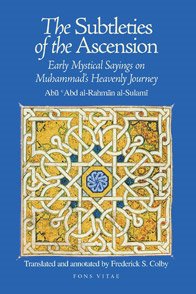
New Fons Vitae Title: Subtleties of the Ascension - The Isra wa Mi'raj; Early Mystical sayings on The Prophet Muhammad’s Heavenly Journey


This first time translation into any language of a recently discovered tenth century manuscript provides a window into the thought-world of the early Muslim mystics known as the Sufis, and offers a comparative case of mystical exegesis for those interested in mysticism more generally.

Fifty-six teachings on a variety of ascension-related issues illustrate the profoundly creative imagination of such early Sufi mystics as Hallaj, Junayd, and Bistami, demonstrating their remarkable ability to mine gems of insight from the deepest depths of spiritual experience, and highlighting their abiding love for the Prophet Muhammad. The book provides the essential framework for both novices and experts to understand how the early Sufis approached the Qur'an and the oral reports attributed to Muhammad, illustrated with stunning masterpieces of 15th century Persian miniature painting. READ MORE

Monday, June 12, 2006

Splendours of Qur'an Calligraphy and Illumination by Martin Lings

Splendours of Qur'an Calligraphy and Illumination by Martin Lings added to Fons Vitae website

The finest examples of this distinctive Islamic art form ever published.

Within three centuries of its advent, Islam had produced an architecture and a calligraphic art, including that of illumination, that have seldom been equaled and never surpassed, the one centered on the Mosque and the other on the Qur'an. But whereas Islamic architecture is world famous, its calligraphic art has remained relatively unknown and inaccessible. Black-and-white photographs of the art of calligraphy are plentiful, but a page of script, impressive though it can be in black and white, loses much without the tints of the paper and the ink.

Splendours of Qur'an Calligraphy and Illumination reproduces the formal excellence of colors and texture that distinguish these artistic masterpieces. In all, 180 openings are displayed, carefully chosen from the greatest collections of Qur'an manuscripts in the world. 180 color large illustrations. Read more

Dalai Lama and Islam conference images


View images from April event organised by Fons Vitae - View Press Release

View world news coverage

On April 15, 2006, His Holiness the Dalai Lama traveled to San Francisco to attend an historic event, embracing his Muslim brothers and sisters, and including other world faiths, to foster mutual understanding and to celebrate our common humanity.

For centuries, Buddhists and Muslims have lived peacefully together as one family in Tibet. This historic gathering was initiated last year when Imam Khorasani of the Bay Area met with His Holiness the Dalai Lama, and the two discussed their mutual desire to overcome the negative perceptions that currently abound in the media regarding Muslims and their relationships with other faiths and peoples. The purpose of this summit was to dispel the illusion that certain religious groups are inherently intolerant and to take back the world stage from the voices of dissension and mistrust who have taken it for political purposes.

At a time when the world is experiencing and witnessing more suffering and rising tensions between faiths, it was the goal of this gathering to promote open discourse about our commonalities centered on dignity, respect, love, and compassion. This event was the first step of many to gather with one voice representing the overwhelming majority of people of faith who live moderate and normative lives of service, mercy, and compassion. The goal: a world without violence, respectful of diversity. This gathering demonstrated to the world that a calm dialogue between a broad cross section of Muslim and other scholars and religious, community, and business leaders highlights the ideals and precepts of each faith that speak from the center of the heart and resonate through all faiths.

The Organizing Committee is deeply grateful for the opportunity to have assisted in this historic gathering to overcome the negative perceptions that currently abound in the media regarding Muslims and their relationships with other faiths and peoples. We are honored to, in some small part, play a role in assembling this summit to begin to dispel the illusion that certain religious groups are inherently intolerant and to take back the world stage from the voices of dissension and mistrust who have taken it for political purposes. We extend our gratitude to all who helped with this event and for those who participated and attended, to make it such a profound success.

The Organizing Committee

Fons Vitae, Zaytuna Institute, The Myers Group, The Kirlin Foundation, Islamic Society of California

Tuesday, May 09, 2006

Dalai Lama urges understanding of Islam

SAN FRANCISCO
Dalai Lama embraces religious tolerance
Buddhist leader urges understanding of Islam, other faiths


The gathering was organized by a volunteer group of individuals and several organizations, including the Myers Group, Fons Vitae, the Kirlin Foundation and the Zaytuna Institute

Referring to himself as one of the "defenders of Islam," the Dalai Lama, the world's most influential Buddhist leader, urged an interfaith gathering in San Francisco on Saturday to promote a pluralistic view of religion.

The Nobel Peace Prize winner said that the era of "one truth, one religion" was reserved for ancient times in which many of the world's religions were founded. But not today.

The Dalai Lama said all believers need to learn understanding for other faiths -- particularly for Islam, because, he noted, oil from the Middle East fuels economies around the world.

"In terms of community, in terms of humanity, the concept of several truths, several religions is very relevant,'' he said.

The Dalai Lama had joined many of the nation's Muslim scholars and leaders in trying to recast the image of Islam, which he believes has been wrongly demonized in America.

In many ways, they were preaching to the converted. The invitation-only event at the Intercontinental Mark Hopkins Hotel included roughly 500 audience members drawn from the same religious and scholarly communities that hosted the event.

"Nowadays, to some people, the Muslim tradition appears different, more militant," the Dalai Lama said. "I feel that's wrong. Muslims, like any of the major traditions, have the same message, the same practice. That is a practice of compassion."

The Dalai Lama also met privately with Muslim leaders, urging them to promote respect for other faiths within their own communities across the nation, said Sayyid M. Syeed, secretary general for the Islamic Society of North America, the most powerful Muslim institution in the nation.

Syeed said it was a message Muslim leaders already believed as a matter of faith. The Quran, which represents the divine teachings revealed to the prophet Muhammad, instructs Muslims that humanity would consist of people of only one faith if it had been so deemed by Allah, the Islamic word for God.

The Quranic verse, Syeed and others at the gathering said, instructs that a diversity of faiths ought to encourage believers to do good within their own systems.

"They will have to look to their own religion," Syeed said.

The message of looking to one's own faith to find unity with others was frequently invoked Saturday.

The Rev. Alan Jones, dean of Grace Cathedral, an Episcopal church, said that even during the holiest week of the Christian calendar, the gathering was helping him "to discover a little more of what it means to be a Christian."

And there was also an acknowledgement that Islam is undergoing dramatic changes.

Sheikh Hamza Yusuf, a popular voice for Muslims in America, said the world's major religions are struggling with modernity -- but none more so than Islam.

Yusuf said the challenges before the world demand that people of all faiths reach out to others.

"The essence of pain and suffering in this world is ignorance,'' said Yusuf, co-founder of the Hayward-based Zaytuna Institute, an Islamic think tank. "We can no longer ignore each other as faith-based communities."

The interfaith message is common in the Bay Area. And this selective audience was primed. Yet several audience members said they came away changed by the messages they heard -- particularly from the Muslim speakers.

"I always felt there was too little coming out from the Muslim community and not capturing the essence of what makes their religion beautiful, compassionate," said Gil Magilen, 62, who is Jewish.

For him, hearing the messages of Muslim speakers affirmed that "our differences are merely different routes toward the same goal: respect for everybody."

Organizers of the event, "A Gathering of Hearts Illuminating Compassion," had also been concerned that religion has become more of a political tool than a spiritual practice.

Continuing that theme, the Dalai Lama concluded the event with a five-minute meditation.

The gathering was organized by a volunteer group of individuals and several organizations, including the Myers Group, Fons Vitae, the Kirlin Foundation, the Islamic Society of California and the Zaytuna Institute.